Economic Calendar
The macro news and events that move the market, with their impact, time and AI analysis, so they don't catch you off guard.
The Economic Calendar is the agenda of the events that move prices: employment data (NFP), inflation (CPI), interest-rate decisions, etc. Each event comes with its impact level (high, medium or low) and the currency or country it affects. In the minutes around a high-impact release, a calm pair can move a full day's worth in seconds — knowing when it's coming is the difference between trading it and being run over by it.
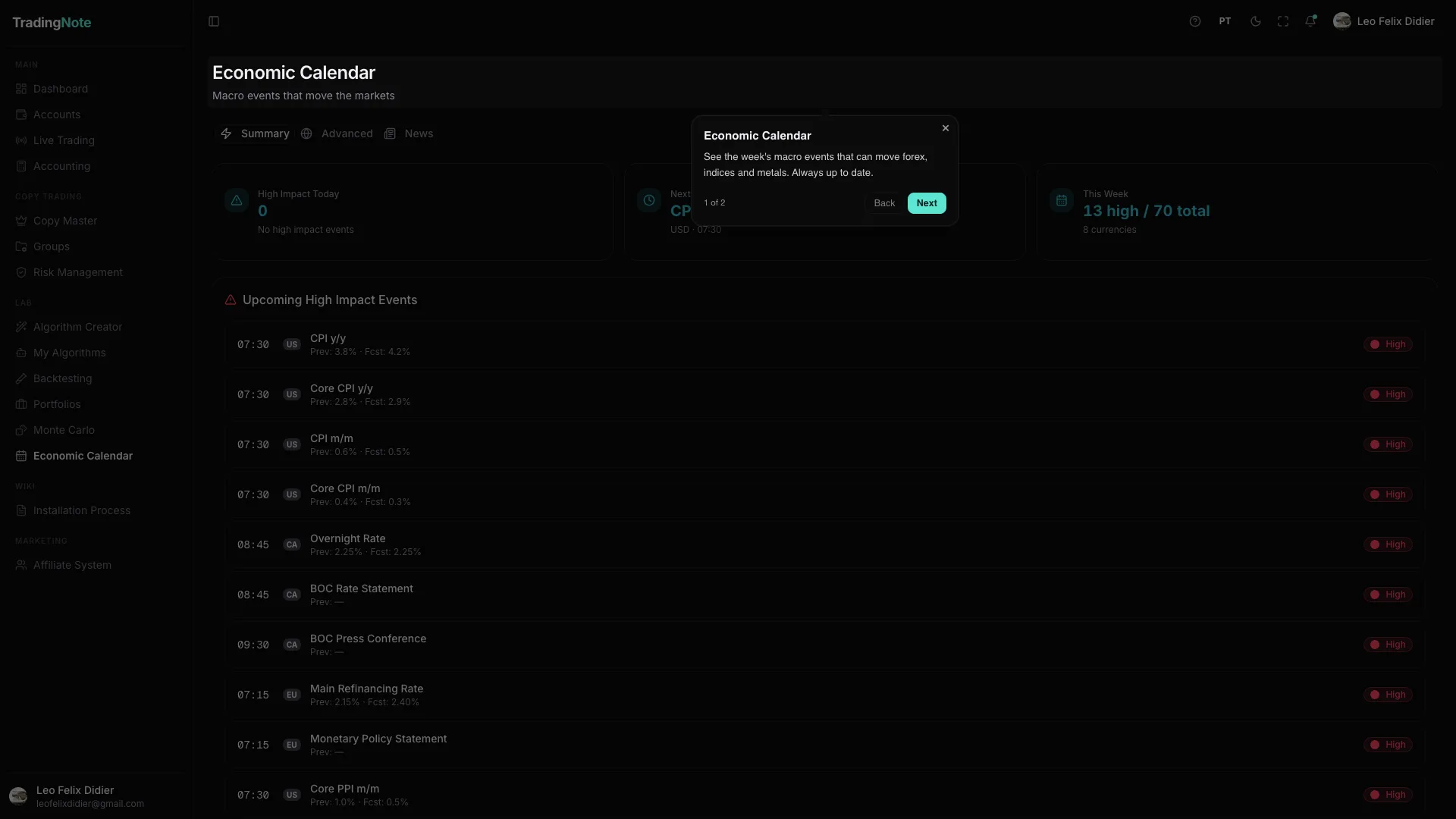
How to read the impact level
| Impact | What to expect | What to do |
|---|---|---|
| High (red) | Sharp moves and spread widening. NFP, CPI, interest rates, central-bank speeches. | Reduce size or wait it out. Don't place tight stops right before. |
| Medium (orange) | Noticeable but more contained reaction. Retail sales, PMI, secondary employment. | Trade aware of the event; watch the volatility. |
| Low (yellow) | Usually goes almost unnoticed in the price. | Normal trading. |
More than dates: context and analysis
Each event can be expanded to see much more than the time: the expected figure (consensus) vs the previous one, the history of recent releases, what that indicator measures and why it matters, and an AI-generated analysis that sums up the context in plain language. You don't need to be an economist to understand what's at stake.
Check the calendar at the start of your day. If there's a high-impact (red) event in the next hours for the pair you trade, consider reducing size or waiting it out: prices can jump sharply and the spread widen at exactly the worst moment.
The calendar isn't just informational: it feeds other parts of TradingNote. Algorithms can take high-impact events into account to avoid trading blind in the middle of news, and the public calendar lets you check it even without logging in.