Risk Management
Set risk limits and protection rules so a bad streak doesn't get out of control — with a fund's rigor: a risk budget per algorithm, caps and account rotation.
Risk Management is your accounts' safety net. Here you set loss caps, exposure control and rules that stop trading when certain limits are crossed. It's what keeps a bad day or a misconfiguration from turning a small loss into a disaster. The uncomfortable truth of trading: surviving matters more than being right, and surviving is exactly what you design here.
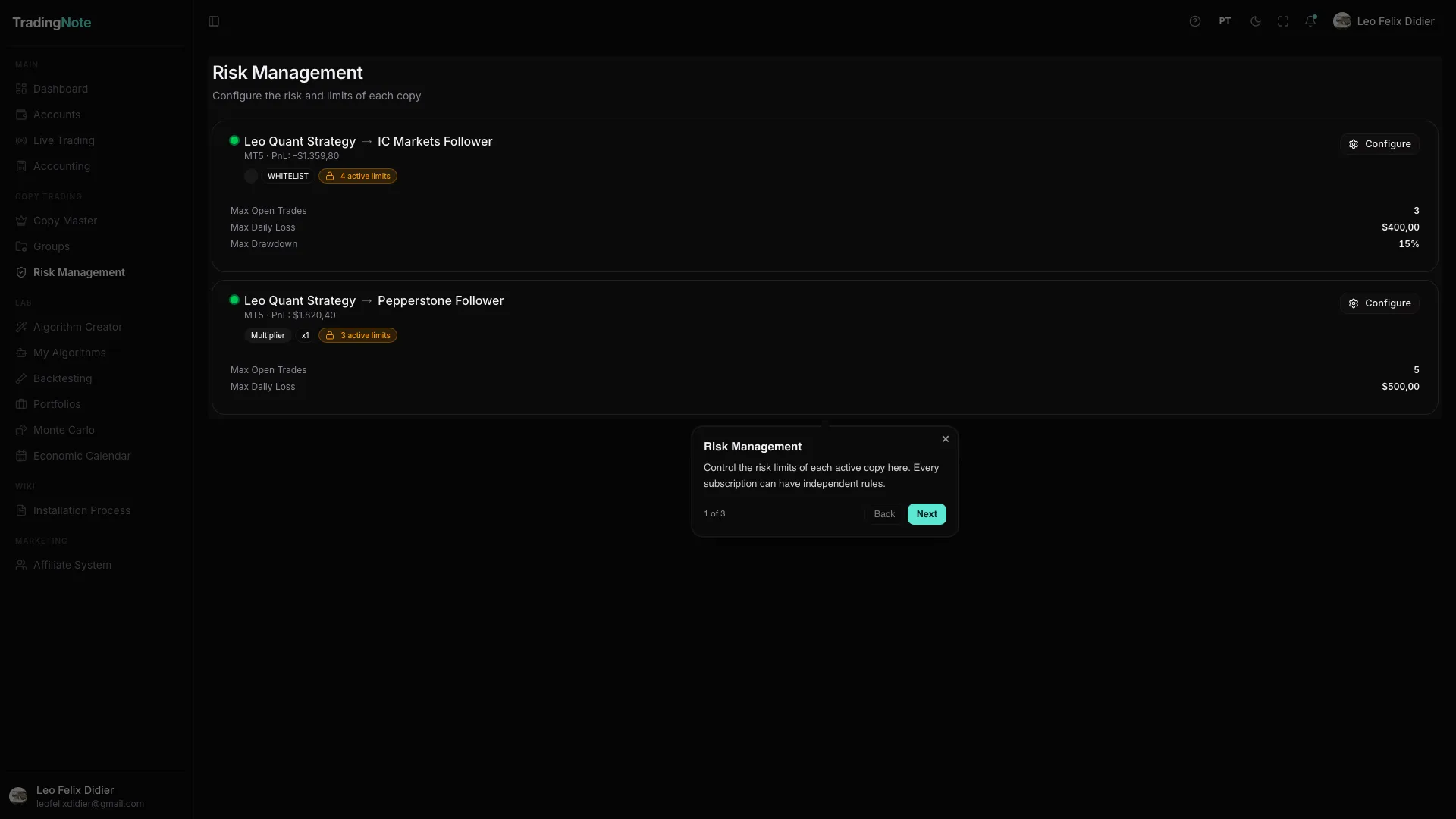
The caps you can set
| Limit | What it does | When to use it |
|---|---|---|
| Max daily loss | If the portfolio loses more than X in a day, it pauses automatically until the next day. | Always. It's the most important limit, especially in prop firms. |
| Max gain (daily/weekly/monthly/total) | Stops trading once you've hit your gain target for the period. Locks in profits. | To avoid giving back to the market what you already earned; key in funding challenges. |
| Simultaneous exposure | How much risk you allow open at once across all positions. | When you run several algorithms and don't want them stacking in the same direction. |
| Max risk per trade | A single position never risks more than a fraction of your daily budget (half by default). | Defense against a sizing error that empties the day in a single trade. |
Institutional mode: a risk budget per algorithm
This is where TradingNote operates like an investment fund and not a loose bot. In institutional mode, you define a daily loss budget for the whole portfolio and it's split among your algorithms by each one's weight. Each algorithm gets its risk «envelope» and sizes its trades to stay within it. No single algorithm can eat into the others' risk.
// Presupuesto de riesgo de cada algoritmo, conceptualmente:
budget_algo = NAV × maxPerdidaDiaria% × (peso_algo / suma_de_pesos)

// Ejemplo: cuenta de 50.000, tope diario 3%, un algo con peso 2 de un total de 5:
// 50.000 × 0.03 × (2 / 5) = 600 USD de presupuesto de riesgo para ese algo hoy.In institutional mode, each algorithm's «assigned weight» drives the sizing; seeing it at 0 inside the portfolio is normal, because the split is computed with the budget logic, not with that loose field.
Account rotation and streak lock
If you trade several accounts (typical in futures prop firms), TradingNote can spread the trading across them instead of firing them all at once. This diversifies the risk of breaking a rule and lets you protect the accounts that are winning.
| Mode | How it distributes |
|---|---|
| Parallel | All accounts trade every signal at once (the classic mode). |
| Round-robin by signal | One trade per account, alternating on each new signal. |
| Round-robin by day | One account trades all day; at close, it rotates to the next. |
| Streak lock | If an account hits its target N days in a row, it pauses and the cursor advances — you protect the gains. |
If you trade prop-firm accounts, set the limits here BEFORE you start. Breaching a prop firm's daily loss limit almost always means losing the account — and many use «trailing drawdown», which raises your threshold every time you win. Set your TradingNote daily cap BELOW the prop firm's to keep a margin, and never disable it mid red-day.
Combine Risk Management with Groups: group your follower accounts and apply the same caps to the whole group in one shot, instead of account by account.