Algorithm Creator
Discover trading algorithms automatically, no coding. You launch an exploration and the platform searches for you — and filters out overfitting before showing them to you.
The Algorithm Creator is the heart of TradingNote: a machine that discovers trading strategies for you, without writing a single line of code. You launch an «exploration» and the platform tests thousands of combinations of indicators and parameters over historical data, then returns the algorithms that worked best. You just pick the ones you like. It's the difference between hand-coding a system for weeks and letting a machine explore the space of possibilities in minutes.
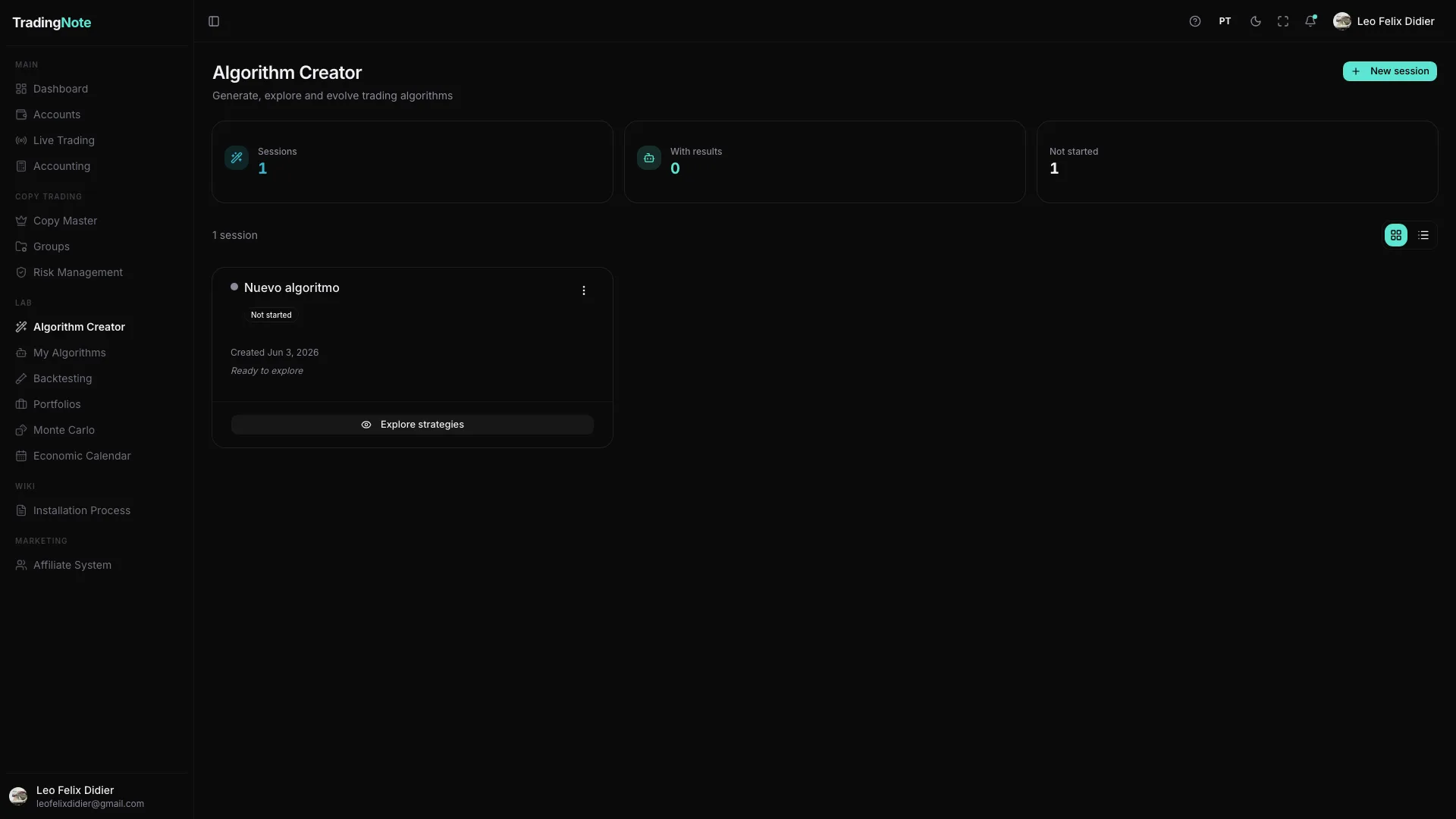
How to launch your first exploration
- 1
Create a new session
Press «New session» (top right). A session is a project for searching algorithms: it groups all the explorations you run around the same idea.
- 2
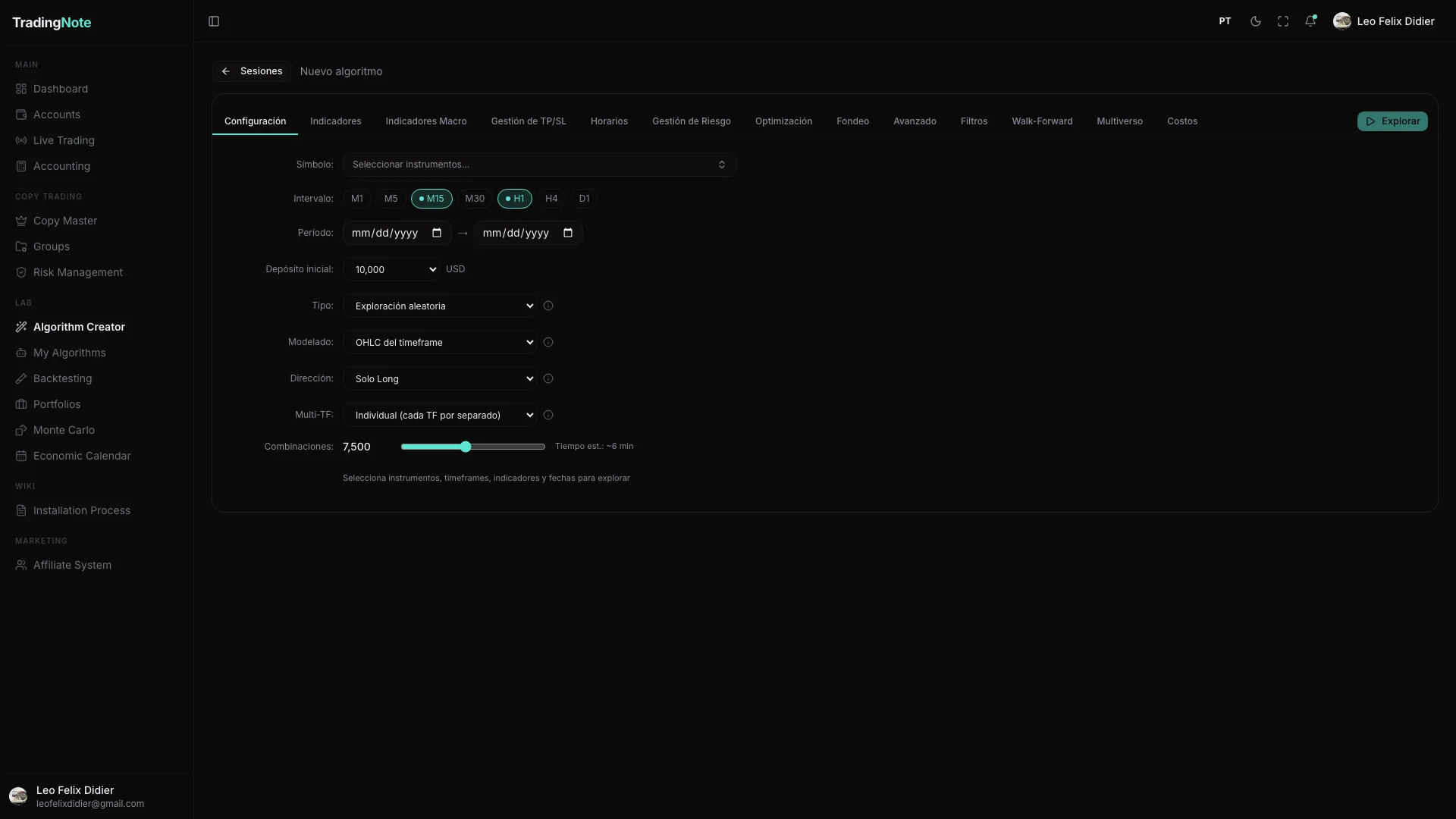
Define what to search
You choose the instrument (pair or asset), the timeframe and the date range. The platform will automatically test many indicators and combinations over that data.
- 3
Choose the search engine
Random (covers a lot of ground fast) or genetic (evolves the best ideas like natural selection). Below we explain when to use each.
- 4
Press «Explore strategies»
The exploration begins. The platform generates candidate algorithms and filters them by robustness. You can watch it live, even in a 3D view called «Neural Explorer» that draws the search like a neural network.
- 5
Review the candidates
When it finishes, the algorithms that passed the filters are saved. You'll find them in the «My Algorithms» section to study in detail.
Random vs genetic: which engine to choose
Generates random combinations within the space you defined. It's like casting a wide net into the sea: it covers a lot of ground fast and is ideal for a first exploration of an instrument you don't know yet. If you don't know where to start, start here.
Mimics natural selection: it starts from a population of algorithms, keeps the best, «crosses» and «mutates» them generation after generation. It converges toward good solutions while spending less compute on the bad ones. Use it once you've seen an instrument has potential and want to refine the search.
What happens underneath (and why it matters)
The Creator doesn't just look for whatever made the most money: it aggressively filters out overfitting before showing you anything. That's its real value. It's easy to find by chance an algorithm that looks perfect in the past; the hard part is finding one that will work in the future. That's why every candidate goes through robustness filters, and most are discarded.
An exploration returning few algorithms (or none) isn't a failure: it's the system doing its job. In many markets, the robustness filter discards over 95% of high-Sharpe candidates, precisely because that Sharpe was a product of luck. A few solid algorithms are worth more than hundreds of mirages.
Heavy explorations run on dedicated infrastructure that's spun up just for your search and shut down when it finishes. How many you can run at once depends on your plan; if one is queued, wait for the previous one to finish or upgrade for more capacity.
Don't settle for the first «pretty» algorithm that shows up. A good result in the past doesn't guarantee the future: that's why there's a deep validation step (DSR, Walk-Forward, Multiverse) you'll see in «My Algorithms». Exploring is just the first step; validating is what separates a trader from a gambler.